SEO professionals and digital marketers are watching their tried-and-true tactics lose steam as search engines get smarter and user behavior shifts. The game is changing fast, and what worked in 2023 won't cut it in 2026.
This guide is for SEO specialists, content marketers, and business owners who want to stay ahead of the curve and understand how Generative Engine Optimization (GEO) will reshape search marketing.
You'll discover why traditional SEO strategies are hitting a wall and learn the specific GEO tactics that'll drive real results in 2026. The search landscape isn't dying—it's just demanding a completely different playbook.
Why Traditional SEO Strategies Are Losing Their Edge
Search engines prioritize user experience over keyword density.
In this blog post in 2023, I shared that the top SEO ranking factor was consistently sharing high-quality content and encouraged you to focus on providing value to your website visitors. At that time, having keywords throughout your site and in your title tags was the 2nd key ranking factor.
Going into 2026, posting high-quality content and focusing on user experience are more important than ever. Google's algorithm updates over the past few years have shown that stuffing keywords into your content no longer works. The days when you could rank by repeating your target phrase 20 times in a 500-word article are long gone. Search engines now focus on how real people interact with your website.
Page loading speed, mobile responsiveness, and content quality matter more than ever. When someone lands on your page and immediately bounces back to search results, that sends a negative signal. Search engines track these behaviors and adjust rankings accordingly.
The shift toward user experience means search engines evaluate factors like:
Time spent on page: How long visitors stay engaged with your content
Click-through rates: Whether your search result titles and descriptions compel clicks
Core Web Vitals: Technical metrics measuring loading performance, interactivity, and visual stability
Content depth: Whether your content actually answers the searcher's question
This change rewards websites that create genuine value for visitors rather than those that game the system with keyword tricks. Brands that still rely on keyword density tactics often see their rankings drop as competitors focus on creating better user experiences.
AI-powered algorithms can detect and penalize outdated tactics
Modern search algorithms use machine learning to spot manipulation tactics that worked in the past. These AI systems analyze content patterns, link structures, and user behavior signals to identify attempts at gaming the system.
Keyword stuffing, hidden text, and low-quality backlink schemes trigger algorithmic penalties faster than ever. The AI can recognize when content reads unnaturally or when backlinks come from irrelevant, low-authority sources. These detection capabilities become more sophisticated with each algorithm update.
Common outdated tactics that now trigger penalties include:
Exact match anchor text: using the exact keyword you want a page to rank for in all your hyperlinks
Article spinning: rewriting articles to create many “new” versions that all say the same thing and posting them across platforms
Private blog networks: a group of websites owned or controlled by the same person, created for the purpose of linking back to a main website to artificially boost its search rankings
Thin content pages: web pages that have very little useful or original information for users. They provide minimal value, often just a few sentences, repeated content, or automatically generated text
The shift means SEO professionals must abandon quick-fix strategies and focus on building genuine authority and relevance.
Voice search and mobile-first indexing reshape ranking factors
Voice search queries differ dramatically from typed searches. People speak in complete sentences and ask specific questions rather than typing fragmented keywords. This change affects how search engines interpret and rank content.
Mobile-first indexing means Google primarily uses the mobile version of your website for ranking and indexing. If your mobile site lacks content or functionality compared to your desktop version, your rankings suffer across all devices.
These changes create new optimization requirements:
Natural language optimization: Content must match how people actually speak and ask questions
Featured snippet optimization: Voice assistants often read featured snippet content as answers
Local search relevance: Voice searches frequently include location-based queries
Page speed on mobile: Slow-loading mobile pages lose rankings and voice search visibility
The combination of voice search growth and mobile-first indexing requires a complete rethinking of content strategy. Successful websites now optimize for conversational queries and ensure their mobile experience matches or exceeds their desktop version. Traditional keyword-focused approaches miss these fundamental shifts in how people search and how search engines evaluate content.

Understanding GEO: The Future of Search Optimization
Defining Generative Engine Optimization and its core principles
Generative Engine Optimization (GEO) represents a fundamental shift in how we approach search visibility. Unlike traditional SEO, which focuses on ranking web pages higher in search results, GEO centers on optimizing content to be selected, cited, and featured by AI-powered search engines like ChatGPT, Bard, and Bing Chat.
The core principles of GEO revolve around three main pillars:
Authority and Credibility: AI systems prioritize sources that demonstrate expertise, authoritativeness, and trustworthiness. This means creating content backed by data, research, and clear sourcing becomes critical for visibility.
Contextual Relevance: Generative engines analyze not just keywords but the entire context of queries. They seek comprehensive, nuanced answers that address user intent at multiple levels.
Structured Information Architecture: Content must be organized in ways that AI can easily parse, understand, and extract relevant information from. This includes clear headings, logical flow, and factual precision.
GEO also emphasizes answer-first content creation. Instead of building pages around keywords, successful GEO strategies focus on providing direct, actionable answers to specific questions users ask. The goal shifts from driving clicks to becoming the authoritative source that AI engines reference when generating responses.
How AI-generated responses change user search behavior
AI-powered search engines have dramatically altered how people seek and consume information online. Users now expect immediate, comprehensive answers without having to click through multiple links. This behavioral shift creates new challenges and opportunities for content creators.
The conversation-style interface of AI search tools encourages users to ask more complex, multi-part questions. Instead of typing "best CRM software," users might ask "What's the best CRM software for a 50-person marketing agency with a $10k budget that integrates with Salesforce?" This specificity demands content that addresses nuanced scenarios rather than broad topics.
Key behavioral changes include:
Zero-click expectations: Users want complete answers within the AI response
Follow-up queries: Conversational interfaces lead to deeper, more specific questions
Context-dependent searches: Users provide more background information in their queries
Trust in AI curation: People increasingly rely on AI to filter and synthesize information from multiple sources
This evolution means traditional metrics like page views and click-through rates become less relevant. Success in the GEO era depends on being cited as a source, having your expertise recognized by AI systems, and building authority that makes your content the go-to reference for specific topics.
The shift from ranking pages to being featured in AI summaries
The traditional goal of appearing in the top 10 search results has been replaced by the objective of being featured in AI-generated summaries and responses. This shift requires a complete rethinking of content strategy and optimization tactics.
AI engines don't just rank pages—they synthesize information from multiple sources to create comprehensive answers. Your content might be one of several sources cited in a single AI response, meaning you're competing not just for ranking but also for inclusion in a curated selection of authoritative sources.
What this means for content creators:
Instead of keyword density and placement, provide thorough explorations of topics
Instead of meta descriptions and titles, have clear factual statements
Instead of focusing on backlink quantity, focus on source credibility and accuracy
Instead of obsessing over page load speed, focus on content structure and readability
Instead of click-through rates, focus on citation worthiness
The most successful GEO strategies focus on becoming the definitive resource on specific topics rather than trying to rank for broad keywords. This means creating in-depth, well-researched content that AI systems can confidently cite as authoritative. When your content becomes a trusted source for AI engines, you gain visibility across countless related queries without needing to optimize for each specific keyword combination.
Success in this new landscape requires thinking like a reference librarian rather than a traditional marketer. The question becomes: "What would make an AI confidently cite this content as a reliable source?" rather than "How can I rank higher than my competitors?"
Top ChatBot Recommendation Factors
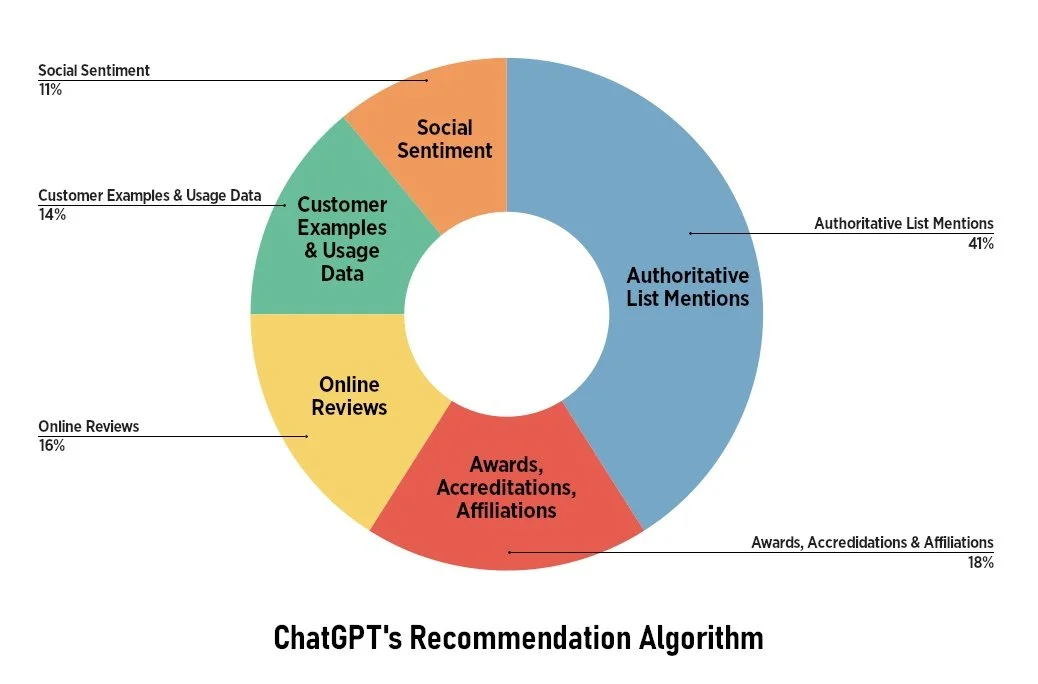
Each generative AI engine has its own method for generating content. I am going to focus on ChatGPT and Google Geminis’ Recommendation Algorithm as explored by First Page Sage in this article.
According to First Page Sage, four of the top factors that influenced AI recommendations are:
Authoritative List Mentions: external recognition of your business from other reputable sites
Google Website Authority: Google’s assessment of your site’s overall credibility and strength
Online Reviews: online reviews from trustworthy platforms such as Amazon, Better Business Bureau, Glassdoor, TrustPilot, etc.
Awards, Accreditations, and Affiliations: recognitions or memberships that show your business is trustworthy and authoritative in its local area.
For example, ChatGPT relies on Bing (which relies on Google…) for lists, reviews, and directories that rank highly. It will scan the top-ranked Bing search result, verify their authority, and then create its own recommendation based on those sources. If there is conflicting information, ChatGPT looks for awards, accreditations, affiliations, and online reviews to curate an answer.
Google Gemini’s recommendation algorithm relies on Google’s systems, such as Google Business, Google reviews, etc. It searches the first page of Google for companies that have been cited as award-winning and those that have good online reviews to curate an answer.
How to Get Your Content Selected by AI Chatbots
1. Keep using your SEO Strategies
A lot of the SEO Strategies you have already been doing will translate well to the GEO landscape with some tweaks and additions.
AI Bots pull from the top-ranked search results. So, you must be on the first page of Google before your website has a chance at being selected by the AI Chat. According to First Page Sage, the 2025 Top Ranking Factors are consistent publication of high-quality content (ideally twice a week), having keywords in your meta title tag, backlinks, niche expertise, and user engagement. Although the importance of keywords is disappearing fast, producing high-quality content that provides value and answers searchers’ questions will establish you as an expert in your niche (building authority) and increase time spent on the page (building credibility).
2. Create content that answers complex, multi-part queries.
AI systems now excel at understanding queries that contain multiple layers of intent. Instead of targeting single keywords, successful GEO strategies focus on addressing the complete user journey within a single piece of content. When someone searches "best project management software for remote teams with a budget under $50, integration with Slack," they're asking several questions at once: What are the options? Which work for remote teams? What's the pricing? How does Slack integration work?
Your content needs to address each component while maintaining natural flow. Start by identifying the primary question, then map out all related sub-questions users might have. Structure your content to answer these comprehensively, using clear headings and logical progression. This approach signals to AI that your content provides complete value, making it more likely to be featured in AI-generated responses.
The goal is to create high-quality content that provides a ton of value; think complete guides and detailed breakdowns, instead of quick “how-tos”.
3. Optimize for conversational and natural language patterns
People don't talk to AI like they used to search Google. They ask questions the same way they'd ask a knowledgeable friend. "What should I look for when buying a laptop for graphic design work?" sounds nothing like the old-school "best graphic design laptop specs."
Your content should mirror these natural speech patterns. Write as if you're having a conversation with your reader. Use questions as section headers. Include the phrases people actually use when speaking. If someone might say "Is this any good?" then include that exact phrase in your content, followed by your answer.
Long-tail conversational phrases are becoming the new keywords. Instead of optimizing for "SEO tools," focus on "which SEO tools actually help small businesses rank higher" or "what's the easiest SEO tool for beginners to start with." These longer, more specific phrases match how people communicate with AI assistants.
In addition, focus on content structure and readability with clear factual statements to help AI Chatbots make sense of your content.
4. Boost Your Online Reputation and Authority
Trust and authority play a huge role in your content being selected by AI Chatbots.
First, take heart knowing that your own website can lead the way in presenting who you are online. Your content and copy can set up your online reputation. In the past, we would put keywords throughout our site and build backlinks, but now the focus needs to be on credibility and written social proof. Add these to your own website, including testimonials and reviews
Work on increasing your Authoritative List Mentions. These are different from backlinks in the sense that they can be a non-clickable mention (just your brand name). Try producing some high-quality guides or resources that are genuinely useful and relevant to your industry. You can also use tools like Google Alerts to be alerted when your brand name is mentioned on another site and build relationships with those sources. Partnerships, guest posts, or mentions from authoritative figures increase your chances of being listed.
Apply for industry or local awards and certifications, which often get listed online. Make sure you have an updated Google Business Profile and try to get as many positive (authentic!!) reviews as you can.
In other words, focus on the credibility and reputation of your brand online to increase your citation worthiness.
5. The Technical Parts
You wesbite needs to provide a good user experience and be properly set up for the AI ChatBots to parse.
You may have heard of Schema Markup. It is essentially code you can add to your site to improve how search engines read and display your site in search results. Squarespace does a lot of this for you, but you can add some of your own. This is optional and is not required in order for your site to show up in search results. However, if you want to look into this more, I suggest checking out this article by Collaborada.
I recommend focusing on ensuring your content has a clear structure so that AI can easily extract information.
Headings
Use Heading 1s, 2s, etc, appropriately to break the content down into chunks
Use subheadings that mirror search queries people actually use
Paragraphs
Provide a direct answer in the first 50 words of a paragraph (not necessarily within the first 50 words of the article)
Lead with the most important information, then expand with supporting details
Use numbered lists for processes and step-by-step instructions
Use bullet points for feature comparisons and quick facts
Links and URLs
URL structure should incorporate natural language patterns rather than abbreviated keywords. Use hyphens to separate words and create URLs that could function as readable sentences. (NOTE: Do not change the URLS of pages that are already established. This will cause broken links and you will loose any SEO/GEO that you have already build up on the page)
Link related concepts using descriptive anchor text that includes semantic variations and synonyms. Avoid generic phrases like "click here" or "read more." Instead, use contextual phrases that help AI understand the relationship between linked content.
In Conclusion
The digital landscape is shifting rapidly, and what worked in SEO yesterday won't cut it tomorrow. Traditional keyword stuffing and basic optimization tactics are giving way to GEO strategies that prioritize user experience, context, and genuine value. Smart businesses are already adapting by focusing on building their online authority, credibility, and reputation while providing high-quality long-form content optimized for AI Chatbots.