How to Optimize Existing Blog Posts for GEO (Without Rewriting Everything)
Your blog posts are sitting there with untapped potential. They're already ranking, getting some traffic, but missing out on AI search opportunities that could triple their visibility.
This guide is for content creators, bloggers, and marketers who want to optimize existing blog posts for GEO without starting from scratch. You've already done the hard work of creating quality content—now it's time to make it work harder for you.
If you haven’t already, I suggest first checking out my post “SEO Isn’t Dead — It’s Evolving: How GEO Will Dominate in 2026” to understand why traditional SEO strategies are hitting a wall and the specific GEO tactics that'll drive real results in 2026.
Then come back to this post where we'll walk through how to audit your current posts to spot AI visibility gaps and strategic ways to weave in relevant keywords and context without rewriting entire sections. You'll also learn to add direct answer blocks that AI systems love to pull from, plus simple restructuring tricks that make your content more "snippetable" for voice searches and featured results.

#1) Audit Your Existing Posts for AI Visibility
Identify High-Potential Content
Start by digging into your Google Search Console data to uncover hidden gems in your existing content library. To do this, click to see the performance on Search Results. Choose a time frame and filter by your blog URL. Select Pages from the table and sort by Position.
Look for posts that previously ranked in the top 10 but have slipped down the rankings – these show Google once trusted your content, making them prime candidates for optimization. You can also look for posts that have a high number of impressions and clicks, but are not making their way to the 1st page of Google. This means that when people see it, they are interested, but it probably won’t be selected by AI.
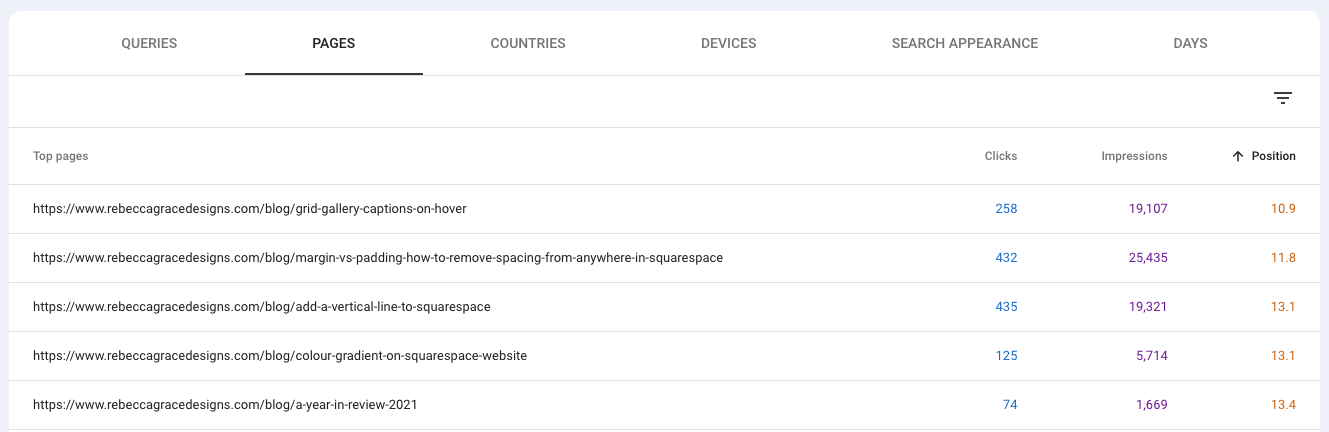
Focus especially on content that answers direct questions: "how-to" guides, "what is" definitions, comparison posts, and troubleshooting articles. These formats align perfectly with how people interact with AI tools and voice search. Your data will reveal which topics still drive impressions but aren't converting to clicks, signaling an opportunity to better match search intent.
Don't overlook seasonal content that performed well during its peak time. A holiday marketing guide that ranked well last December but needs fresh data can quickly regain its position with minimal updates.
Test with AI Tools
Here's where you become your own detective. Take your article's main topic and search for it across ChatGPT, Claude, Perplexity, and Google's AI Overviews. Pay attention to which sources these tools cite and recommend.
If your content doesn't appear in AI responses, that's valuable feedback. It means AI systems either can't easily parse your information or don't view it as authoritative enough to reference. This test reveals exactly where you stand in the AI visibility landscape.
Try different variations of your topic – ask the question multiple ways, use related keywords, and see if your content surfaces. Document which competitors consistently appear in these AI responses, as they're your benchmarks for optimization.
Identify Gaps
Compare your content side-by-side with the sources AI tools currently favor. Look for specific elements they have that you're missing:
Clear definitions and terminology sections
Numbered lists and step-by-step processes
Data points, statistics, and recent research
FAQ sections that address common follow-up questions
Examples and case studies that illustrate concepts
Find Posts That Are Almost Winning
These represent your biggest quick-win opportunities. Run a search console report filtered for:
| Position Range | Traffic Pattern | Optimization Priority |
|---|---|---|
| Top 5 | Not the featured snippet | High - restructure for snippets |
| Positions 6-10 | Stable impressions but low CTR | Medium - improve title/meta |
| Positions 11-20 | Declining impressions | High - needs immediate attention |
For posts in the top 5 position, check to see if they are being selected by AI or as a featured snippet when searching for those keywords or phrases. Not all searches in Google will have a featured snippet. If they do, it is generated automatically. So, it is not a guaranteed position but it is worth setting your post up to have the best shot at being selected. Check out this article by Woorank on how to find your featured snippets and how to structure your content to improve your chances.
For posts in positions 6 -10, you want to find posts that have stable impressions but low click-through rates. Try improving the SEO title and description to encourage clicks.
Finally, for posts in position 11 - 20, you want to find posts with solid fundamentals – good word count, relevant keywords, decent backlinks – but outdated examples, broken internal links, or poor formatting. These posts already have Google's trust; they just need technical polish and content freshening.
Pay special attention to posts that lost traffic after major Google updates. These often need authority signals strengthened or content gaps filled rather than complete rewrites.

#2) Restructure Content for AI “Snippetability”
AI systems work differently from humans when they scan your content. While you might read top to bottom, AI models chunk information into digestible pieces, looking for clear patterns and logical connections. The better your content structure, the easier it becomes for AI to extract precise answers and feature your content in search results.
Think of AI as a speed reader with perfect memory but zero patience for wandering paragraphs. It wants quick access to specific information without having to decode unclear formatting or confusing text blocks.
Convert Vague Headings to Question-Based Headings
Transform generic headings into specific questions your audience actually asks. This simple change dramatically improves your content's AI visibility.
Before and After Examples:
| Vague Heading | Question-Based Heading |
|---|---|
| "Tips for Better Sleep" | "How Can You Fall Asleep Faster at Night?" |
| "Email Marketing Benefits" | "Why Does Email Marketing Generate Higher ROI?" |
| "Social Media Strategy" | "Which Social Media Platforms Work Best for B2B Companies?" |
Question-based headings serve dual purposes: they match natural search queries and create clear content boundaries that AI can easily identify and extract.
Break down massive text walls into bite-sized sections. Large paragraphs overwhelm both AI parsers and human readers. Each paragraph should focus on one main idea with 3-5 sentences maximum.
Use these formatting elements to boost scanability:
Bullet points for listing features, benefits, or steps
Numbered lists for processes, rankings, or sequential information
Comparison tables for presenting alternatives or specifications
Short paragraphs that focus on single concepts
Pay Attention to Your Heading Hierarchy
Your heading structure creates a roadmap for AI systems navigating your content. Proper hierarchy helps AI understand your content's organization and locate specific information quickly.
Follow this logical flow:
H1 for the blog post title
H2 for major topic sections
H3 for subtopics within those sections
H4 for detailed points under subtopics
Never skip heading levels. Jumping from H2 directly to H4 confuses AI parsers and disrupts the logical content flow. Each heading should clearly preview the information that follows, acting like a mini table of contents for that section.
Strong heading hierarchy also improves user experience, making your content easier to skim and navigate on any device.
#3) Add a “Direct Answer” Block at the Top of Your Post
AI engines and language models scan content looking for clear, structured answers they can quickly deliver to users. Think of them as extremely fast readers who want the main point immediately rather than digging through long paragraphs of background information.
Because of this, AI systems prioritize content that follows a simple structure: direct answer first, supporting details second. This mirrors how people search today. If someone asks a question, they want the answer right away—not after several paragraphs of context.
One of the easiest ways to improve your content for GEO is to add a direct answer block near the top of your post.
Start with a 2–3 sentence summary (about 50–75 words) that clearly answers the main question your article addresses. Place this summary immediately after your introduction so it can function as a stand-alone answer that AI systems can easily extract.
Next, include a clear definition of the main topic within the first 100–200 words. Strong definitions explain what the concept is, what it does, and why it matters.
Finally, use bold formatting to highlight key ideas, statistics, or takeaways so both readers and AI tools can quickly identify the most important information.

#4) Strengthen Authority and Trust Signals
Search engines and AI systems have gotten incredibly sophisticated at detecting trust signals within content. They're looking beyond just keywords to evaluate whether your content comes from a reliable source that deserves to be recommended to users. Your existing blog posts might contain great information, but if they lack proper authority markers, AI might skip over them entirely when choosing sources for responses.
The shift toward AI-driven search results means algorithms are acting more like librarians than simple keyword matchers. They want to recommend content that won't embarrass them or mislead users. This creates an opportunity: by adding strategic trust signals to your existing posts, you can dramatically improve their chances of being selected as authoritative sources.
Increase the likelihood that AI trusts your content as a source
Building trust with AI systems requires demonstrating the four pillars of E-E-A-T: Experience, Expertise, Authority, and Trust. Each pillar reinforces the others, creating a compound effect that signals to AI that your content deserves serious consideration.
Experience shows you've actually done what you're writing about. If you're discussing marketing strategies, include specific results from campaigns you've run. For technical tutorials, mention the tools you've used and problems you've solved. AI systems are trained to recognize authentic experience markers versus generic advice copied from other sources.
Expertise goes deeper than experience - it's about demonstrating comprehensive knowledge of your subject area. This means using industry terminology correctly, referencing current best practices, and showing awareness of nuances and exceptions. Your content should read as if it comes from someone who truly understands the field, not just someone who researched it for an hour.
Authority comes from external validation. This includes mentions by other reputable sites, social media engagement, and recognition within your industry. While you can't control all authority signals, you can influence them by creating content worth linking to and citing.
Trust encompasses everything from technical factors like HTTPS and site security to content factors like accuracy, transparency, and regular updates. AI systems evaluate trust holistically, looking for consistency across multiple signals.
Add trust signals without major rewrites
Adding a "Last Updated" date to your posts signals freshness and ongoing maintenance. Place this prominently near the title or author byline. When you do update content, make sure the changes are substantial enough to warrant the new date - AI systems can detect superficial updates designed just to game freshness signals.
Including credible statistics transforms opinion-based content into fact-based content. Replace vague statements like "many businesses struggle with..." with specific data: "According to HubSpot's 2024 State of Marketing report, 73% of businesses cite lead generation as their primary challenge." The key is using recent data from recognized industry sources.
Citing reputable sources throughout your content creates a web of authority. Link to peer-reviewed studies, industry reports, government data, and established publications in your field. Each citation acts as a vote of confidence in your content's reliability. Don't just link - explain why the source matters and how it supports your point.
Your author bio deserves more attention than a simple name and title. Include specific credentials, years of experience, notable achievements, and links to your professional profiles. If you've worked with recognizable brands, mention them. The bio should answer the question: "Why should I trust this person's advice?"
Real examples and case studies separate authoritative content from generic advice. Instead of theoretical scenarios, share actual results from real situations. Include specific metrics, timelines, and outcomes. Even if you need to anonymize details, concrete examples demonstrate practical experience that AI systems recognize as valuable.
#5) Expand Context With Internal Links and Related Terms
Think of AI like a curious student trying to understand your expertise. When you publish a single blog post on a topic, AI may struggle to see how it fits within your overall knowledge. But when that post connects to related articles, AI can better understand the breadth of your expertise.
One of the best ways to create this context is through strategic internal linking.
Step 1: Link to Supporting Content
Add internal links that connect your article to other posts on related topics. This helps both readers and AI systems navigate your content and see how your knowledge fits together.
Start by identifying your pillar posts (broad, foundational topics) and link to supporting articles that explore specific subtopics.
For example, a post about content marketing strategy could link to articles on:
Content calendar planning
Audience research
Performance tracking
Step 2: Build Simple Topic Clusters
Organize your content into topic clusters—groups of related posts centered around a main theme.
A simple structure looks like this:
Pillar page: Covers the main topic and links to subtopics
Supporting posts: Dive deeper into specific questions
Related articles: Cross-link between closely related topics
This structure helps AI systems recognize that your website offers comprehensive coverage of a topic, increasing the likelihood that your content will be surfaced in AI-powered search results.
Put it all Together: Your GEO Optimization Checklist
Your Complete GEO Action Plan
| Area | Action Required | Primary Goal |
|---|---|---|
| Intro Section | Add a 2-3 sentence, direct answer block | Get featured in AI snippets and voice search results |
| Headings | Transform statements into natural questions (H2/H3) | Match how people actually ask voice assistants |
| Body Content | Break up dense paragraphs, add bullet points and numbered lists | Improve AI readability and parsing |
| Citations | Include 1-2 fresh, properly cited data points | Boost authority signals (E-E-A-T) |
| Links | Add internal links and create topic clusters | Showcase your expertise |
Start with your highest-traffic posts first. These already have established authority and backlinks, making them prime candidates for quick GEO wins. Focus on posts that currently rank on page 1 but aren't capturing featured snippets yet.
Then move to posts in positions 11 - 20. Go through the complete GEO Action Plan and then track your progress by monitoring which posts start appearing in AI-generated responses. Tools like SEMrush and Ahrefs now show featured snippet opportunities, but you can also test this manually by asking ChatGPT or other AI tools questions related to your content topics.
Finally, try improving the click-through rate of your posts in positions 6 - 10 by improving the SEO Title and Description.
Remember to maintain your content's original voice and expertise while making these adjustments. The goal isn't to write for robots, but to make your existing human-focused content more accessible to AI systems that are increasingly mediating how people find and consume information online.
Once you've implemented your GEO optimizations, don't wait around for Google to naturally discover your changes. Head straight to Google Search Console and request a manual recrawl of your updated URLs. This simple step can accelerate your visibility in AI-powered search results by weeks or even months.
The beauty of GEO optimization lies in working smarter, not harder. Start with your highest-traffic posts and work through your optimization checklist systematically. Your content already has value – now it just needs the right tweaks to speak AI's language and get discovered by the next generation of search technology.
Resources Used:
Neil Patel: What Is Generative Engine Optimization (GEO)?
Growth Hackers: How to Optimize Existing Blog Content for Generative Engine Optimization (GEO)
Hiero Graphx: The Easy Update That Can Boost Traffic Without Writing Anything New
Symptoms of Living: 5 Ways to Optimise an Existing Blog Post for SEO